
German Flour Has a Number. American Flour Has a Label.
One of Them Actually Means Something. German Flour Types explained.
Good flour doesn’t need fixing.
You ate bread in Germany. You ate pasta in Italy. You felt fine. Now you’re back home staring at a bag of “enriched” flour wondering what, exactly, was added back – and why it needed to be added in the first place.
The Traveler’s Question Nobody Answers Honestly
Ask anyone who travels to Europe and the story is remarkably consistent: they ate everything – croissants in Paris, pretzels in Munich, ciabatta in Rome – and felt fine. Then they came home, had a sandwich, and the familiar discomfort rolled back in.
The internet has a ready answer: it’s the gluten. European flour is better. American flour is practically toxic.
That’s too clean. And it isn’t quite the full picture.
The honest answer is that it’s several things – and understanding each one is more useful than blaming a single ingredient.
First: you ate differently. In France, breakfast is a coffee and a croissant – eaten sitting down, without a phone in hand. In Germany, Abendbrot – literally “evening bread” – is a full meal. Sliced rye, open-face, at a table, with people, with time. It’s a ritual, not a transaction. Digestion begins with how you eat. The nervous system needs to be in a calm state to do its job properly. Eating on the go, at a desk, or between meetings is a physiological compromise – regardless of what the bread contains.
Second: the wheat itself is different. American agriculture leans heavily on hard red winter and spring wheats, bred for high protein yields and durability in long supply chains. European wheats – particularly in Germany and France – tend to be softer varieties, with a different protein structure. Not weaker. Different. The gluten in a French baguette wheat is not chemically identical to the gluten in US all-purpose flour, and those differences matter to the gut.
Third: the fermentation is different. A traditionally made German sourdough or French levain undergoes 12 to 24 hours of slow fermentation. That process partially breaks down the gluten structure and reduces certain compounds that cause digestive distress in sensitive people. A commercial American sandwich loaf can go from mixer to shelf in under three hours. The bread hasn’t had time to do what fermentation does.
And then there’s the flour itself.
“Enriched” – A Word That Deserves More Questions
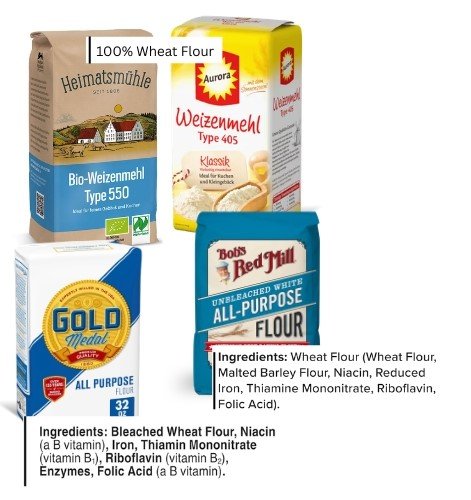
Pick up almost any bag of all-purpose flour in the United States. Somewhere on the label, you’ll find it: enriched flour. Iron. Niacin. Thiamine. Riboflavin. Folic acid. Added back.
Added back. That phrase quietly admits something: the nutrients were there to begin with. They were removed.
The honest question is: why does flour need to be fixed? And why does the label announcing the fix get to sound like a selling point?
In Germany (and other European countries), flour doesn’t need to be enriched. The milling philosophy is different. The end product isn’t optimized first and foremost for the longest possible shelf life.
German flour is produced closer to its natural state – and what you get is flour that still behaves like flour, not a refined industrial substrate with a vitamin patch.
American flour isn't bad. It's optimized for the wrong thing - for industrial scale, shelf life, and a nutritional gap that existed in 1930s. German flour was never asked to do those things. It was asked to make good bread.
The Numbers That Actually Tell You Something – German Flour Types Explained
German flour is classified by a numbering system based on mineral content – specifically, the milligrams of ash remaining when 100 grams of flour is incinerated. Higher number: more of the whole grain is present, more minerals, more flavor, denser texture. Lower number: more refined, lighter, finer.
It’s not poetry. It’s information.
| German Type | Ash Content | Protein | US Equivalent | Best Used For |
| Type 405 | 0.40–0.45% | 8–9% | Cake flour | Pastry, fine baking, delicate cakes |
| Type 550 | 0.50–0.60% | 10–11% | All-purpose flour | Bread, rolls, pizza dough |
| Type 812 | 0.75–0.90% | 11–12% | Between AP and bread flour | Mixed breads, rustic loaves |
| Type 1050/1200 | 0.95–1.25% | 12–13% | High-extraction flour | Hearty breads, rye blends |
| Type 1600 | 1.60–1.80% | 13–14% | Whole wheat (rough) | Whole grain baking, seeded loaves |
| US FLOUR — FOR REFERENCE | ||||
| Cake flour | — | 7–9% | — | Tender cakes, fine pastry |
| All-purpose | — | 10–12% | — | General baking, cookies, quick breads |
| Bread flour | — | 12–14% | — | Yeasted breads, pizza, bagels |
| Whole wheat | — | 13–14% | — | Dense loaves, added fiber |
The “approximate equivalents” column deserves a caveat. The US classification system doesn’t work the same way. American flour is categorized primarily by protein content – cake flour at the low end, bread flour at the high end, all-purpose somewhere in the middle. Protein content and mineral content are related but not the same measurement. A German Type 550 and a US all-purpose flour will behave similarly in many recipes. They are not identical products, and bakers who’ve worked with both feel the difference.
Type 550 is the German workhorse. If you want to replicate a German bread recipe in a US kitchen, starting there and adjusting hydration and type of flour slightly is your most reliable path.
The ‘Abendbrot’ Principle
There’s a concept embedded in German food culture that doesn’t translate easily – not because the word is complicated, but because the idea is. Abendbrot, as mentioned at the beginning, means evening bread. It’s the third meal of the day – cold, built around good bread, cheese, cured meats, maybe a hard-boiled egg and some pickles. It’s not a snack. A meal treated with the quiet seriousness Germans extend to things they consider worth doing well.
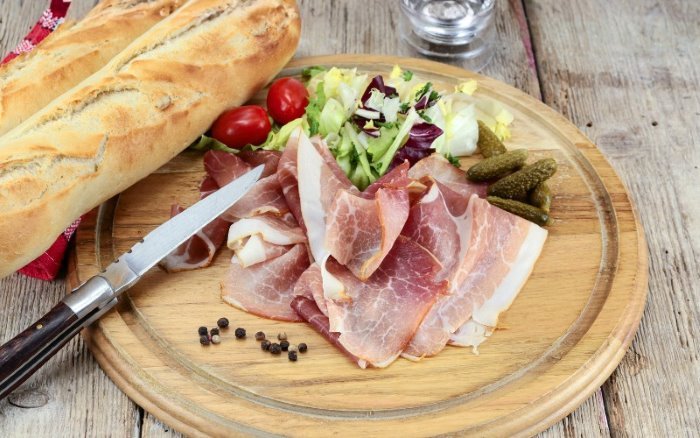
Classic German Abendbrot served on wooden board
In France, a version of this exists in the morning. A coffee – small, real, unhurried – and a croissant or a tartine. No multitasking. No screen in the left hand. The food is the entire event for those fifteen minutes.
This isn’t romanticism. It’s a fundamentally different relationship with eating, and it has real physiological consequences. The digestive system functions better when the body isn’t simultaneously managing a commute, a presentation, or an inbox. The bread you ate in Munich or Lyon wasn’t only different flour. It was eaten differently, at a different pace, in a different mental state.
Relearning that rhythm is arguably more impactful than changing your flour brand. Though changing your flour brand doesn’t hurt.
What This Means in Your Kitchen
None of this means European-style baking is out of reach from a US kitchen. It means it requires a little more intentionality – which is, arguably, the point.
Fermentation time is not optional. If a recipe says overnight, it means overnight. The slow ferment is doing biochemical work that a quick proof cannot replicate. This matters especially for people with non-celiac gluten sensitivity, who are often reacting to under-fermented dough as much as to gluten itself.
Read the flour label like an adult. “Enriched” means stripped and partially patched but please pay attention: sometimes the add-ons are just listed in (). “Unbleached” is a meaningful improvement over bleached. “Whole wheat” varies enormously by how much bran actually remains – the label doesn’t tell you enough. Where possible, source stone-milled or minimally processed and organic flour.
Fewer ingredients is a philosophy, not a constraint. Traditional German bread – the kind baked in homes across Bavaria, Saxony, and Baden for generations – uses flour, water, salt, and time. That is the recipe. Everything else is a workaround for an ingredient list that got too long or a production timeline that got too short.
The gap between American and German flour isn’t just a technical story. It’s a story about what we asked our food systems to optimize for – and whether those priorities still make sense. Eighty years is a long time to keep the same answer to a question the world has mostly moved past.
It’s time to arrive in the modern world.
About the Author
Tanja is the founder of BREADISTA, a Los Angeles-based artisan bread brand rooted in German baking tradition. She grew up baking in Germany with German flour types, moved to LA, and couldn’t find the flour nor the bread she was raised on – so she started making it. BREADISTA bread mixes contain three ingredients. That’s intentional.
Read further about ‘Enriched Flour’ in this blog post.
Always made with organic flour – our bread mixes, so you can enjoy your Abendbrot like a German.
