
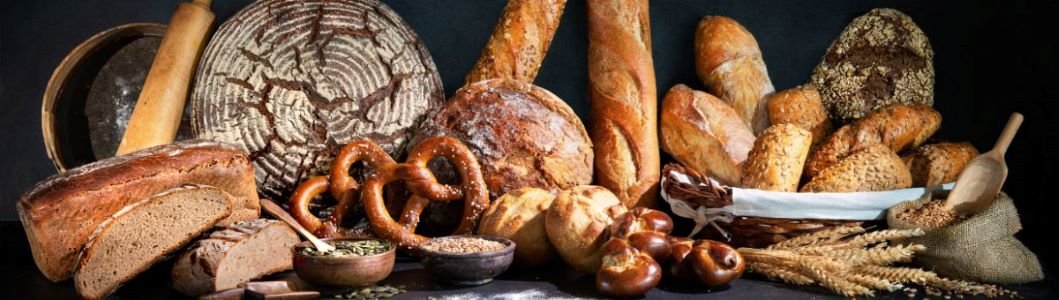
German Bread Culture: A History of Craft & Tradition
A century-old German tradition that’s on revival course
A Renaissance of Modernism
More Than 3,000 Breads: Why Germany Takes Its Bread More Seriously Than Almost Anyone
This article is about what Germany built around bread, how it got there, and what it says about a culture that still – after centuries of war, reunification, industrialization, and the unstoppable convenience of the supermarket – considers its bread a matter of national pride. And rightfully so.
“The first thing I do when I land in Germany is find a bakery.” Not the hotel. A bakery. It doesn’t matter how early it is. There is something about walking through that door – the smell of crust and yeast and something older than both – that resets something in me.
Living in Los Angeles, I can get excellent food. Tacos that would make anyone in the world rethink their priorities. Sushi that belongs in another dimension. But bread – real bread, the kind that has a specific name for a reason, the kind you pull apart and feel the resistance before it gives – that took years to find here. And I never fully stopped looking.
| Before the Supermarket: How German Bread Culture Was Built
German bread culture did not arrive fully formed. It was assembled slowly, over centuries, out of necessity, community, and – as tends to happen in German history – an impressive amount of regulation.
In medieval Germany, most households did not own an oven. Ovens were expensive to build and even more expensive to fuel. So villages built communal ones – Backhäuser – shared wood-fired structures where families brought their own dough and baked in rotation. Bread was not yet a product. It was a collective act, a shared resource, something that required your neighbor’s cooperation to make at all.
Baker guilds emerged in the 13th and 14th centuries and formalized what had been informal. Bread was now regulated – its weight, its ingredients, its price. A baker caught selling underweight loaves faced genuine consequences: public shaming rituals, fines, in some cases worse. The idea that bread quality was a civic matter, not merely a commercial one, was baked into the system early.
The Brezel – which the rest of the world calls the pretzel – entered this tradition as a guild symbol and has never really left.Its twisted shape appears in manuscripts from as early as 1111 AD, making it one of the oldest documented pastry forms in European history. The competing stories of its origin are half the charm: a Swabian baker’s prayer made edible, a solar symbol co-opted by Christianity, a desperate bargain between a medieval baker and a count who wanted something ‘through which the sun can shine three times.’ Nobody knows which is true. Germans make them anyway.
The oldest operating bakery in Germany, Bäckerei Adl in northern Bavaria, was founded in 1392 and is currently in its 14th generation of the same family. Let that sit for a moment. Fourteen generations. The same family, the same trade, through the Thirty Years’ War, through Napoleon, through two world wars, through reunification. Some of their baking equipment is over a century old. Their Hefezopf – a sweet braided yeast bread with a nut filling – follows a recipe that is more than 300 years old. People still drive hours for it.
When Germany received UNESCO recognition for its bread culture in 2014, Deutsche Post (German Postal Agency) issued a commemorative stamp series. A country that prints postage for its bread deserves some respect.
The UNESCO recognition itself was no honorary gesture. German bread culture was classified – alongside the French gastronomic meal and the Argentine tango – as living cultural expression sustained directly by human skill.
The German Bread Register (Brotregister), the first archive of its kind, was created to document this heritage: bakers who are guild members can register their individual bread creations, preserving them as part of a permanent cultural record. As of 2024, the register holds 3,023 officially documented bread specialties. And that is only what has been submitted.
| The Geography of the Crust
Germany is not one bread country. It is several, arranged loosely by latitude and shaped by soil, climate, trade routes, and centuries of regional stubbornness.
The further north you travel, the darker and denser the bread becomes. Rye dominates – not by preference alone, but by practicality. Rye tolerates sandy, acidic northern soils that would defeat wheat. The Hanseatic trade network spread rye-based baking traditions across the northern coast, and the proximity to Scandinavia reinforced them.
Pumpernickel, the famously dense and nearly black loaf from Westphalia, is the extreme expression of this tradition. Requiring 16 to 24 hours in a steam oven. It lasts for weeks. It tastes like something that remembers winter.
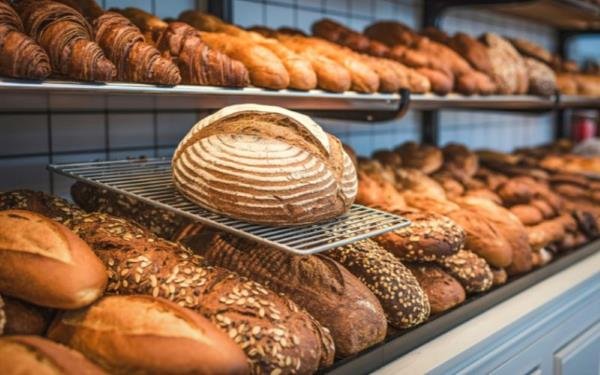
Move south and the shelves change. Mid-Germany and the south – Bavaria, Baden-Württemberg, and the regions bordering Switzerland – lean toward wheat and spelt, seeded loaves, mixed flours, and a wider range of shapes. This is where variety reaches its peak. A well-stocked Bäckerei in Munich or Stuttgart might offer a wall of 15 to 20 different loaves on a given morning: different rye ratios, spelt blends, four-grain mixes, sunflower seeds, pumpkin seeds, linseed, poppy. Each with a specific name and a specific customer who has been buying it for 30 years.
Switzerland belongs in this conversation – and often gets left out of it. The Swiss take their bread with the same seriousness as their German neighbors, shaped by the same alpine agricultural traditions, the same relationship between harsh terrain and hearty grain. The darker, denser varieties that emerge along the alpine edge are a shared inheritance between the two countries. Austrian baking culture on the other hand has its own distinct character, more pastry-forward, more Viennese in its sensibility.
For American context: a typical US artisan bakery in 2026 might carry sourdough in white, whole wheat, with sesame, occasionally with some rye percentage added in. That is a respectable range by American standards. A typical small to mid-size German Bäckerei carries 10 to 15 varieties of loaf as a matter of course – and considers anything less to be a limited selection. These are not the same type of institution, and the gap between them is not a matter of scale. It is a matter of what a culture has decided bread is.
| Abendbrot – When Bread Is the Meal
There is a concept in German domestic life that does not translate particularly well: Abendbrot. Literally: evening bread. Practically: the meal where bread is not a vehicle or a side, but the point.
The table is set – and what goes on it is bread, cold cuts, cheese, pickles, tomatoes, perhaps a soft-boiled egg or two. No plates, but wooden boards. No cooking required. Just good bread and the time to sit down together. For generations of German families, this was not the meal you had when there was no time to cook a real dinner. It was the real dinner.
In Bavaria and Austria, a similar tradition goes by Brotzeit – literally ‘bread time’ – and tends to involve a cold beer, and considerably less hurry than the rest of the week demands. These are not nostalgic artifacts. Abendbrot is still practiced in millions of German households, still considered a proper meal, still something that requires the right bread.
Growing up, Abendbrot was the meal that felt most like home. Not Sunday roast, not holiday dinners – the ordinary evening, the bread on the board, everyone at the table. That specific comfort is harder to explain than it sounds, and we still enjoy it that way here in the US.
| The Numbers Behind the Obsession
Germany consumes close to 57 kilograms of bread and baked goods per household annually (40 kg of bread alone) – and even as household sizes have shrunk from the traditional family of four toward one- and two-person arrangements, overall consumption has stayed remarkably stable. Draw your own conclusions about where the bread is going.
The craft baking industry – the Bäckerhandwerk – generated €17.92 billion in revenue in 2024. It employs 235,000 people across 8,912 registered master craft bakeries, with an additional 35,000 branch locations. That is a significant economic force built entirely around the proposition that bread is worth making properly.
The Deutsches Brotinstitut – the German Bread Institute – publishes research, sets quality standards, and each year formally names a Brot des Jahres: a Bread of the Year. The selection is based on cultural significance, regional tradition, and baking craft. It is announced with the gravity of a state occasion. This is, to be clear, a country that holds an annual bread election.
Germany holds an annual bread election. The Brot des Jahres is selected each year by the German Bread Institute with the gravity of a state occasion.
And then there is the stamp. When the UNESCO recognition came through in 2014, Deutsche Post issued a commemorative stamp series honoring German bread culture. Alongside the Eiffel Tower, the Brandenburg Gate, and the faces of scientists and philosophers – bread. On postage. Because of course.
| The Tragedy of Convenience
Here is the uncomfortable part.
In the 1950s, the old West Germany had roughly 55,000 craft bakeries. By the end of 2024, that number had fallen to 8,912. The decline is not a recent phenomenon – it has been steady and, according to industry experts, shows no sign of reversing. The causes are not mysterious.
Large supermarket chains and discount retailers have invested heavily in in-store baking stations – Backstationen – where par-baked, often frozen loaves are finished on-site and sold fresh. The quality is, it should be said, genuinely decent. Better than what the American supermarket bread aisle offers by a considerable distance. But it is not the same thing as what the Bäckerei around the corner produces, and it costs significantly less. The customer standing in the checkout line at 7pm on a Tuesday makes a rational decision. The craft bakery loses anyway.
The apprenticeship problem is equally structural. A baker’s training begins at around 4am. The physical demands are real – heat, heavy lifting, long shifts before most people’s alarms go off. The pay during apprenticeship is modest. The path to ownership is expensive and uncertain. Apprenticeship numbers in the baking trade fell from over 6,700 in 2014 to under 4,000 in 2023 – not a selling point for a generation with other options.
The market share of large industrial bakeries – those with over €50 million in annual revenue – has grown from 30% of the total market in 2010 to 40% in 2023. A small number of large operations are capturing an ever-larger share of what Germans eat. The variety survives on the shelf. The craft that produced it is shrinking.
| Gläserne Produktion: the New Bakery Convenience
Something is also growing back. Slowly, unevenly, but with conviction.
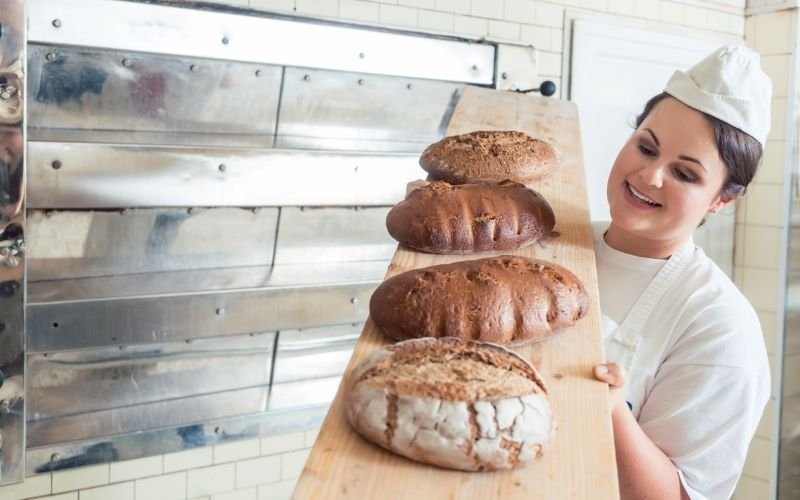
The new wave of German craft bakeries operates on a model that did not exist one, two generation ago. Gläserne Produktion – literally ‘glass production,’ open-kitchen baking – turns the production itself into the experience. You can see the baker score the loaf. You can watch the oven door open. The craft is not hidden in a back room and trusted on reputation; it is the front of house. Transparency as marketing, authenticity as product. It works, because it is true.
These new operations tend to be smaller, more deliberate about their identity, often built as café-bakery hybrids where the slowness of the process is part of the appeal rather than an operational inconvenience. They serve customers who have decided that convenience has been optimized for long enough, and that what they actually want is something made with intention.
The global context matters here. The artisan bread revival is not uniquely German – it crossed the Atlantic some time ago (about 2010) and has been gaining momentum in the US for over a decade. The pandemic-era sourdough awakening was the most visible expression of something that had been building: a broad appetite for bread that means something, that takes time, that asks something of the person making it. American consumers are developing a vocabulary – crust, crumb, fermentation, hydration – that German bakers have been using for centuries.
Germany is not leading this revival so much as it never stopped. The rest of the world is catching up. And for the first time in years, apprenticeship numbers in the German baking trade rose in 2024 – a small sign, and an early one, but real.
| Why This Matters Beyond Germany
I did not move to Los Angeles to become a bread missionary. That was not the plan. But when the thing you miss most is not a place or a person but a specific smell on a Tuesday morning, you start to understand what food actually does in a life.
Breadista exists because the tradition is worth carrying. Not as a museum piece, not as nostalgia, but as a living proposition: that bread made with three ingredients, given enough time, is better than bread made with thirty ingredients in a hurry. The way a culture treats its staple food says something about its values. That it is worth knowing where your bread comes from – and what it took to learn how to make it.
Germany has been making that argument for a thousand years. We are just trying to make it easier to hear it from a kitchen in California.
About the Author
Tanja is the founder of BREADISTA, a Los Angeles-based artisan bread brand rooted in German baking tradition. She grew up in Germany, moved to LA, and couldn’t find the bread she was raised on – so she started making it. BREADISTA bread mixes contain three ingredients with organic flour as the base. That’s intentional.
Q: How many types of bread does Germany have?
A: The German Bread Register officially documents 3,023 registered bread specialties – and that covers only the craft bakeries that have submitted their breads for the record. The commonly cited figure of ‘over 3,000 varieties’ reflects the registered total; the actual number in active production across all regions is likely higher.
Q: When did German bread culture receive UNESCO heritage status?
A: In 2014, the German national UNESCO commission added German bread culture to the federal register of intangible cultural heritage. It was recognized alongside traditions like the French gastronomic meal and the Argentine tango – living cultural expressions sustained directly by human skill.
Q: What is Abendbrot?
A: Abendbrot – literally ‘evening bread’ – is the traditional German evening meal built around bread. It is a cold meal: bread served with cold cuts, cheese, pickles, and whatever else belongs on the board. It is not a snack or a stopgap. For most German families, it is a proper dinner and has been for generations.
Q: What is the oldes bakery in Germany?
A: Bäckerei Adl in Kelheim, northern Bavaria, founded in 1392 and now in its 14th generation of the same family. Some of their equipment is over 100 years old. Their Hefezopf, a sweet braided yeast bread with nut filling, is made to a recipe more than 300 years old.
Q: What is ‘Gläserne Produktion’ in German bakeries?
A: Gläserne Produktion means ‘glass production’ – an open-kitchen approach where the baking process is fully visible to customers. It is a model adopted by many new-generation craft bakeries in Germany, where transparency and visible craft serve as the primary form of marketing. You watch the bread being made. That is the point.
Q: How does German bread differ from American bread?
A: Primarily in variety, fermentation time, and ingredient philosophy. A typical German craft bakery carries 10 to 20 varieties of loaf on any given day – different rye ratios, spelt blends, mixed grains, multiple seed combinations. American artisan bakeries are improving fast, but the range and regional specificity of German bread culture is built on centuries of tradition that simply does not have a shortcut.
Read further about ‘German Brotchen’ in this blog post.
Join our community & be informed when the next article gets published.
Sources: Zentralverband des Deutschen Bäckerhandwerks e.V. - Zahlen & Fakten 2024/2025. baeckerhandwerk.de/zahlen-fakten
Verband Deutscher Großbäckereien e.V. - Ausgewählte Daten und Fakten zum Backwarenmarkt in Deutschland 2024. grossbaecker.de
YouGov / Zentralverband des Deutschen Bäckerhandwerks - Brotkorb der Deutschen 2024.
UNESCO - Immaterielles Kulturerbe Deutschland: Deutsche Brotkultur. unesco.de
Deutsches Brotinstitut - brotinstitut.de/brotkultur
Bäckerei Adl, Kelheim - baeckereikrauss.de (oldest operating bakery, est. 1392)