
Gluten Didn’t Ruin Your Relationship With Bread. – The Bread Did.
72% of people on a gluten-free diet have no medical reason to be on one
~30% of Americans are actively avoiding gluten – without a celiac diagnosis
| The Break-Up
Somewhere in the last fifteen years, a lot of people broke up with bread. And for many of them, they felt better afterward. Less bloating. More energy. Lighter. That experience is completely real – nobody is making it up.
But somewhere along the way, “I feel better without bread” quietly turned into “I’m sensitive to gluten.” Those two sentences are not the same thing. One describes a personal experience. The other is a medical diagnosis. And collapsing the two has created one of the most widespread nutritional misunderstandings of our time.
This is not an article defending gluten. It is not telling anyone what to eat. What it does is look a little more honestly at what the evidence actually says – and ask a different question than most articles bother with: not whether gluten is the problem, but whether the bread is.
| Let’s Get the Numbers Straight
Three distinct groups of people avoid gluten. They have almost nothing in common except what they don’t eat.
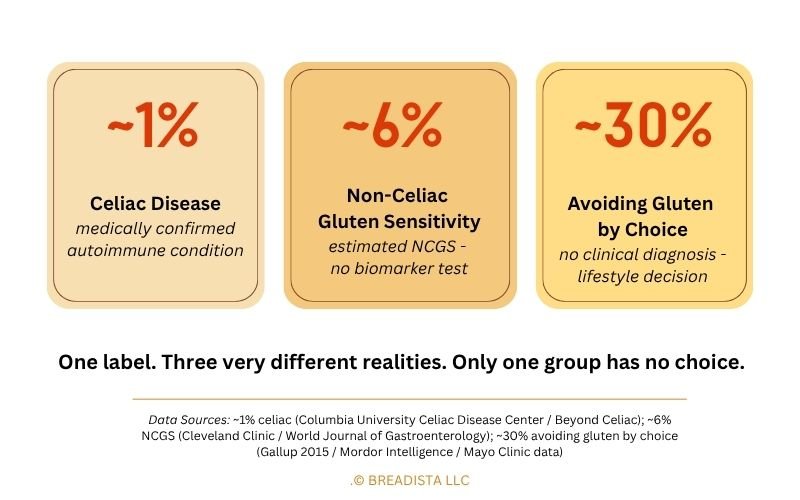
Celiac disease is a serious autoimmune condition affecting roughly 1% of the population. When someone with celiac eats gluten, their immune system attacks the lining of the small intestine. There is no threshold for “a little bit.” Gluten-free is non-negotiable, for life.
Non-celiac gluten sensitivity (NCGS) is estimated to affect up to 6% of Americans. The symptoms are real – bloating, fatigue, brain fog – but unlike celiac disease, there is no intestinal damage and no reliable biomarker to confirm it. Diagnosis is still based on ruling other things out.
Then there’s the third group. Roughly 30% of Americans are actively avoiding gluten – without a celiac diagnosis, often without any formal testing at all. According to research cited by the Mayo Clinic, 72% of people on a gluten-free diet have no medical reason to be on one. The gluten-free market, now worth over $7 billion globally, has been built largely on this group.
None of this is a judgment. But it does raise a question worth sitting with: if so many people feel better without gluten, and most of them don’t have celiac disease or a confirmed sensitivity – what are they actually reacting to?
| So What Is Gluten, Actually?
Gluten is a protein. More specifically, it is the combination of two proteins – glutenin and gliadin – found naturally in wheat, rye, and barley. When these proteins meet water and are worked through mixing or kneading, they form a stretchy network. That network is what gives bread dough its elasticity. It traps the gas from fermentation, allows the loaf to rise, and gives the final crumb its structure and chew.
Without gluten, bread as we know it does not exist. Which is why gluten-free bread requires a list of compensating ingredients – starches, gums, binders – to approximate what gluten does naturally.
Humans have been eating gluten-containing grains for thousands of years. Wheat was one of the first crops domesticated. Sourdough bread has been made for at least 5,000 years. For the vast majority of human history, bread was a staple – and digestive complaints specifically linked to its protein content were not a widespread cultural phenomenon.
| The protein is not new. The way we make bread is.
| Then Why Does Bread Make So Many People Feel Awful?
This is the question that most gluten conversations skip straight past. And the answer points somewhere unexpected.
Modern industrial bread is not the same product as traditionally made bread. It is faster, cheaper, and engineered for shelf stability – and those goals have consequences for digestion.
First, fermentation time. Traditional bread relies on long, slow fermentation – sometimes 12 to 24 hours or more. Industrial bread is made in a fraction of that time, using higher amounts of yeast to speed the rise. The fermentation step is not just for flavor. It is a biological process during which microorganisms break down compounds in the dough that are otherwise hard to digest.
Second, and here is where it gets interesting: wheat contains fermentable carbohydrates called fructans – a type of FODMAP. In many people, particularly those with irritable bowel syndrome, fructans ferment in the large intestine and cause exactly the symptoms often attributed to gluten: bloating, gas, cramping, discomfort.
A landmark 2018 study published in the journal Gastroenterology found that in people with self-reported gluten sensitivity, fructan challenge produced significantly higher symptom scores than gluten itself. The researchers from Monash University reached a similar conclusion: for most people experiencing symptoms, fructans – not gluten – were the primary trigger.
Long (sourdough) fermentation reduces fructan levels significantly, because the bacteria consume these carbohydrates as fuel. This may explain something many people have noticed anecdotally: that traditionally made bread, properly fermented, sits better in the stomach than a fast-made supermarket loaf – even though both contain gluten.
Third, there’s the question of what else is in the bread. Mass-market loaves routinely contain emulsifiers, preservatives, dough conditioners, added sugars, and – in the US – enriched (and even bleached) flour, which strips the grain of its natural fiber and micronutrients and substitutes synthetic versions.
Any one of these could be contributing to how someone feels after eating. Blaming gluten for the whole experience is a bit like blaming the engine when the whole car is falling apart.
| Most people have never eaten bread the way bread was meant to be made. They’ve only ever eaten the fast version.
| Time Changes Things
Traditional breadmaking is not a trend. It is simply what breadmaking looked like before speed became the priority.
When dough is allowed to ferment slowly – over many hours, with a small amount of yeast or a natural starter – several things happen. Flavor develops. The crumb structure becomes more open. And the composition of the dough changes in ways that matter for digestion: fructans are broken down, gluten proteins are partially modified, and the bread becomes more nutritionally available.
Some customers who describe themselves as gluten-sensitive have reported tolerating long-fermented bread without the symptoms they’d normally expect. That is a reported experience, not a medical claim – and anyone with a diagnosed condition should always work with their doctor, not a bread mix. But it points in the same direction as the emerging research: that fermentation is doing something important that industrial baking has largely eliminated.
Germany has been making bread this way for centuries. The country’s bread culture – diverse, regional, deeply traditional – is built on exactly this principle: slow fermentation, quality grain, no shortcuts. Not as a health trend. Simply because that’s how good bread is made.
| The Gluten-Free Swap Nobody Talks About
For people with celiac disease, gluten-free products are not optional – they are essential. That part of the market exists for a clear reason, and serves a real need.
But for the much larger group choosing gluten-free for perceived health benefits, there is a conversation worth having about what they are actually buying.
Gluten does a lot of structural work in bread. When you remove it, something has to compensate. Gluten-free baked goods typically rely on a combination of rice flour, tapioca starch, potato starch, xanthan gum, and often additional fat and sugar to approximate the texture and flavor that gluten provides naturally. The ingredient list is almost always longer. The product is almost always more processed. And it costs significantly more.
A 2023 survey found that 44% of Americans believe a gluten-free diet improves overall health – regardless of diagnosis. The research does not support this for people without celiac disease or confirmed NCGS. Northwestern Medicine notes directly that “removing gluten from your diet if you don’t have celiac or a gluten intolerance will not improve your digestive or metabolic health.”
| “Free from” is not the same as “better for you.” It just means something was taken out – and usually something else was put in.
This is not about dismissing anyone’s choices. It is about reading the label with the same critical eye you would apply to anything else. A longer ingredient list dressed in clean packaging is still a longer ingredient list.
| So What Should You Actually Do?
If you genuinely suspect a gluten-related condition, the most useful thing you can do is get tested – before changing your diet. Once you have been eating gluten-free for a while, celiac testing becomes unreliable, because the antibody response requires gluten exposure to show up. A doctor can run a blood panel and, if needed, a biopsy. That is the only way to know for certain.
If testing comes back clear and you still experience symptoms after eating bread, it may be worth looking at the bread itself rather than its protein. Try a properly fermented loaf made with clean ingredients. Give it a few weeks. Pay attention to what’s actually in what you’re eating.
And if you’ve been avoiding bread because it never agreed with you – it may be worth reconsidering which bread you’ve been eating. Most people have only ever eaten bread made fast, with stripped flour and a page of additives. That is a very different thing from bread made with three ingredients and twenty-four hours.
Gluten is not the enemy. But industrially made bread does deserve the skepticism it’s been getting. The answer just might be different bread, not no bread.
Real Bread. Real Ingredients. No Shortcuts.
BREADISTA bread mixes are made with organic flour, sea salt, and a small amount of yeast. Long fermentation. No additives. No enriched flour. No sugar. Just bread the way it used to be made – and the way it still tastes best.
Quick answers to your questions
Yes. Many people who react to bread are responding to other components – fermentable carbohydrates called fructans, additives, or highly processed flour – rather than gluten itself. A 2018 study found that fructans triggered significantly higher symptoms than gluten in people with self-reported gluten sensitivity.
Long fermentation partially breaks down fructans (fermentable carbohydrates in wheat) and modifies gluten proteins, which may make traditionally fermented bread easier to digest for some people. It does not eliminate gluten. Anyone with celiac disease must still avoid it entirely.
Not automatically. For people without celiac disease or confirmed NCGS, research does not support health benefits from avoiding gluten. Gluten-free baked goods frequently contain more starches, gums, added sugars, and fat to compensate for what gluten provides structurally – often making them more processed, not less.
Celiac disease is a confirmed autoimmune condition causing intestinal damage – roughly 1% of the population. Non-celiac gluten sensitivity (NCGS) involves real symptoms without intestinal damage or a reliable biomarker test, estimated at around 6%. The two are often conflated but require very different responses.
Yes – ideally before eliminating gluten from your diet. Celiac testing relies on an active antibody response, which requires regular gluten consumption. Once you’ve been eating gluten-free for a period, test results can become unreliable. A doctor can run a simple blood panel as a first step.
