
Cultured Wheat Flour vs Sourdough: Not the Same Thing
Here’s what it actually is, why it’s in your bread, and how to spot it on the label.
intent matters: its chosen because shoppers scanning ingredients for red flags
| What Is Cultured Wheat Flour
Bacteria eat. That’s it, that’s the whole trick.
You take wheat flour, add water, and add a specific type of bacteria – one usually found in cheese-making. The bacteria eat the sugars in the flour and, well, they poop. That “poop” is an acid called propionic acid.
Acid is bad news for mold. Mold can’t grow well in it. So, if you mix this acid-soaked flour into your bread dough, the finished loaf resists mold for longer.
That’s genuinely useful. Nobody wants moldy bread. But here’s the part that gets glossed over: this is the exact same acid – propionic acid, and its salt form, calcium propionate – that shows up on other ingredient labels as E280, E281, E282, or E283. Chemically, it’s the same molecule either way. The bacteria just made it inside the flour instead of a factory making it in a vat.
So, when a label says “cultured wheat flour” instead of “calcium propionate,” you’re not getting a different ingredient. You’re getting the same ingredient with a friendlier name – and, as a bonus for the manufacturer, one that doesn’t legally require an E-number to be listed. Cultured wheat flour sounds like sourdough – it isn’t.
| Wait – So Isn’t That Natural?
Yes and No. Here’s the catch: yes, bacteria are natural. Fermentation is natural. But “natural process” and “natural outcome” aren’t the same thing.
Real sourdough fermentation is slow, messy, and different every time – the wild yeasts and bacteria in your starter shift with temperature, humidity, even the flour batch. Cultured wheat flour is the opposite: one specific bacterial strain, standardized conditions, grown in a lab or factory setting, dried into a consistent powder that behaves the same way every single time. That consistency is the entire point – a factory can’t put “vibes” on a spec sheet, it needs a reliable percentage of propionic acid, batch after batch.
So, the ingredients are natural. The process that turns it into a shelf-stable powder additive is industrial engineering. That’s the difference between a backyard garden and a fertilizer plant that also, technically, “just uses nature.”
Another comparison: ‘Natural Flavors’. They are made with ingredients occuring in nature, but that does not mean banana or strawberry flavor is actual made from such. Put simply – those natural flavors are imitations of the flavor you want to achieve. It’s cheaper, way cheaper and more controlable. That said, cultured wheat flour may sound like sourdough – it isn’t.
| Why Is Cultured Flour In Your Bread
Manufacturers didn’t add cultured wheat flour for flavor, or because it’s traditional. They added it to solve three very specific industrial problems:
- Shelf life. Bread has to survive a truck ride, a warehouse, and a supermarket shelf for a week or two – not the day or two a real bakery loaf lasts.
- Softness on demand. The organic acids also affect crumb texture, keeping mass-produced bread soft even after sitting in plastic for days.
- Clean-label pressure. Consumers started rejecting E-numbers and negative sounding ingredient, so the industry needed something that does the same job without triggering a “chemical-sounding” red flag on the label.
That third point is the real story here – it’s not a baking innovation. It’s a labeling response to shoppers getting smarter.
| The Label Trick
Food labeling law requires additives to be named – usually by their E-number, so shoppers can spot them. Propionic acid and calcium propionate are no exception: E280, E281, E282, E283.
But if a manufacturer ferments the propionic acid inside a flour instead of adding it as a standalone chemical, the rules change. Now it’s not “an additive,” it’s an “ingredient” – cultured wheat flour, or fermented wheat flour, or just fermented flour. No E-number required on the label.
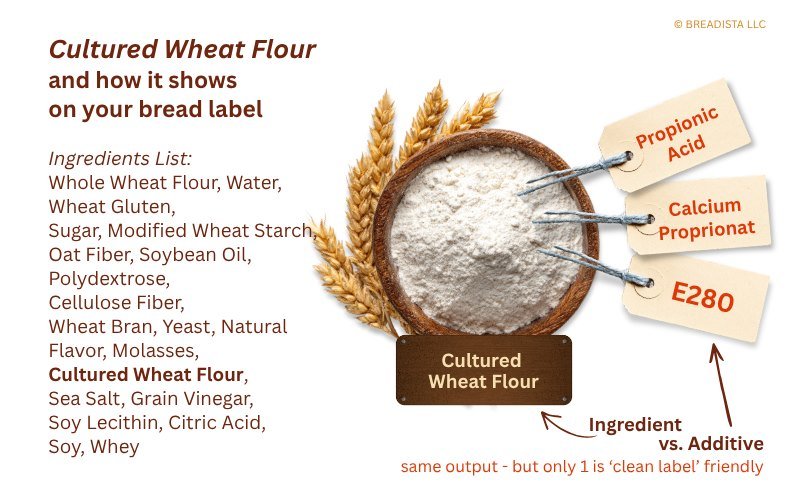
There’s a second trick in the placement. Ingredients are listed by weight, heaviest first. Cultured wheat flour makes up just 1–5% of the flour used – so it lands near the bottom of the list, sitting quietly next to the word “flour.” It reads like a minor ingredient. It’s actually doing a specific chemical job.
Nothing about any of this is illegal. It’s a legitimate use of the regulation, and food scientists will tell you the declaration question genuinely isn’t simple – a fermented product is always a mix of compounds, not one clean chemical. But intent matters here: the word and its position were both chosen because they read better to a shopper scanning ingredients for red flags. That’s not an accident of chemistry. That’s a labeling decision, twice over.
And, while you’re on it, reading the labels, worth checking also this article – helps you spot added vs. real fiber.
| The Sourdough Mix-Up
This is where most people get quietly misled – not by a lie, but by a word doing more work than it should.
“Cultured.” “Fermented.” Say either one near bread or flour, and most people’s brains jump straight to sourdough: slow-rising, gut-friendly, the kind of bread your grandmother’s neighbor used to bake. That association isn’t an accident either – it’s exactly why these words were chosen over “propionate” or “preservative.”
Real sourdough fermentation takes many hours, sometimes days, breaking down gluten and starches in ways that change flavor, texture, and digestibility. Cultured wheat flour is fermented for a specific industrial outcome – a stable acid content – then dried into a powder and added like any other ingredient. It never rises your bread. It never replaces yeast. It has nothing to do with the slow-fermentation benefits people associate with the word “sourdough.”
If a loaf’s ingredient list has “cultured wheat flour” it’s conventional bread with a preservative wearing a costume.
| Real Fermentation vs. This
Here’s the technical difference, stripped of jargon: real fermentation is unpredictable, and that’s the whole point.
When a baker ferments dough the traditional way, the outcome depends on the flour’s own natural microflora, the water ratio, the temperature, how long it’s left to sit. Different variables, different acids, different flavor every time. According to baking consultant Stanley Cauvain, that natural mix is dominated by wild yeasts and lactic acid bacteria that hitch a ride on the wheat itself – no two batches behave quite the same.
Cultured wheat flour is built to remove that unpredictability. One specific bacterial strain, standardized conditions, dried into a powder engineered to deliver a consistent acid level batch after batch. That’s not a flaw – for a factory shipping millions of loaves, consistency is the goal. But it means the word “fermented” is doing double duty: describing a genuine biological process on one hand, and an industrially repeatable specification on the other.
| How to Actually Check Your Bread
You don’t need a chemistry degree to spot this one. Three things to look for on the ingredient list:
- “Cultured wheat flour,” “fermented wheat flour,” or “fermented flour” – any of these is the same ingredient, just named differently by different manufacturers.
- Position near the bottom of the list, close to other minor ingredients – that’s your confirmation it’s a functional additive, not a main flour.
- Yeast also listed – if a loaf has both yeast and “cultured/fermented flour,” it isn’t sourdough. Real sourdough bread rises from wild yeast in the starter and that is usually listed in the beginning of the list.
If you see any of those, you’re looking at conventional bread built for a long shelf life – not a shortcut to sourdough.
Quick answers to your questions
No. Sourdough is a slow, natural fermentation that leavens bread and develops flavor over many hours. Cultured wheat flour is a fast-fermented additive used in small amounts (1–5% of the flour) purely to extend shelf life and improve texture. It doesn’t leaven bread and has no connection to sourdough’s flavor or digestibility benefits.
Yes – it has FDA GRAS (Generally Recognized As Safe) status.
Not really. It produces the same compound – propionic acid and its salts – as the additives labeled E280–E283. The difference is naming, not chemistry.
No. It’s still made from wheat and is not a suitable option for anyone avoiding gluten.
Because it’s fermented inside a flour rather than added as an isolated chemical, it’s classified as an ingredient rather than an additive under labeling rules – so no E-number is required, even though the resulting compound is the same one E280–E283 refers to.
And when you know think you would rather start making your own bread at home, we have your back. 😊
