
The number on the front doesn’t tell you where the fiber came from.
Fiber’s having a moment. Fibermaxxing is everywhere, GLP-1 users need it, and suddenly everyone’s checking the fiber line on a label the way they used to check calories.
That’s a good habit. But the number alone doesn’t tell the whole story. We want to check here the fiber in bread – two loaves can both say “6g of fiber” and mean completely different things.
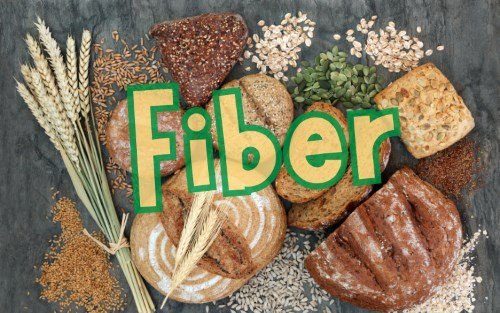
Not All Fiber Gets There the Same Way
Here’s the part that trips people up: not all fiber gets into bread the same way.
A) Whole grain flour – real whole grain, bran and germ still intact – comes with fiber built in. It’s not an ingredient you can see on the label separately, because it’s just part of the flour itself. Along with it comes everything else the grain naturally carries: B vitamins, minerals, plant compounds that get stripped out when flour is refined.
B) Other bread starts from a more refined flour – lighter, fluffier, less fibrous – and then adds fiber back in as its own ingredient: oat fiber, wheat bran, sugarcane fiber, polydextrose, just to name a few. You’ll usually spot it a few lines down the ingredient list, often with “isolated” attached.
Here’s why that difference matters to you, not just in theory: when fiber is added separately, it can hit the same gram number on the label while the rest of the loaf stays closer to white bread – meaning you get the fiber count without the other nutrition that’s supposed to come with it. Some of these isolated fibers (polydextrose especially) also digest differently than fiber still bound in whole grain, and in larger amounts are known to cause bloating or GI discomfort for some people – something whole grain fiber rarely does, since your body’s been processing it the way food naturally provides it for a very long time.
The check is simple: if the fiber source is its own separate ingredient, it was added. If the only flour listed is “whole wheat” or “whole grain” and nothing else, the fiber came with it.
Sign Up to be the 1st to know about a new blog post
Two Labels, Side by Side
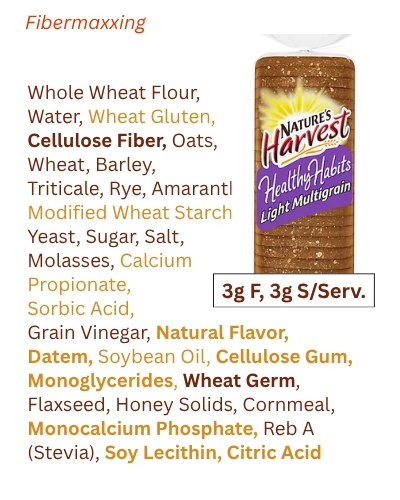
Both of these loaves are marketed around fiber and protein – one even calls itself out as an “excellent source.” Look at where the fiber source actually sits in each ingredient list: is it the flour itself, or something added further down? What’s the serving size and what do you actually eat?
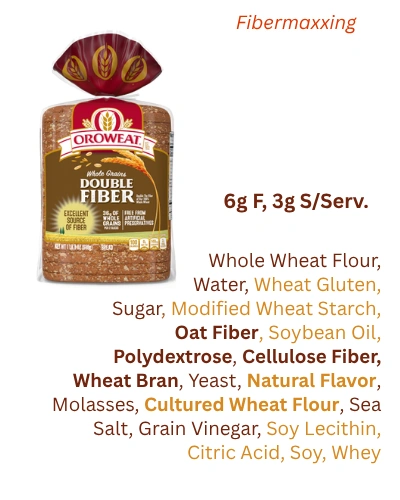
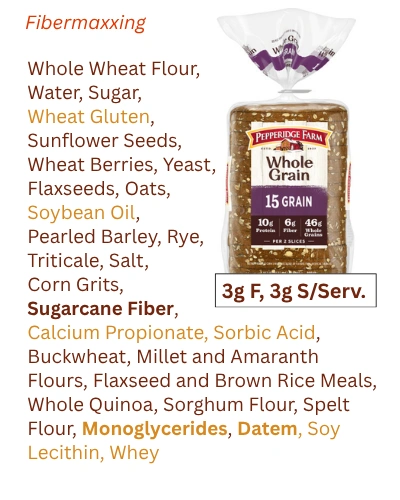
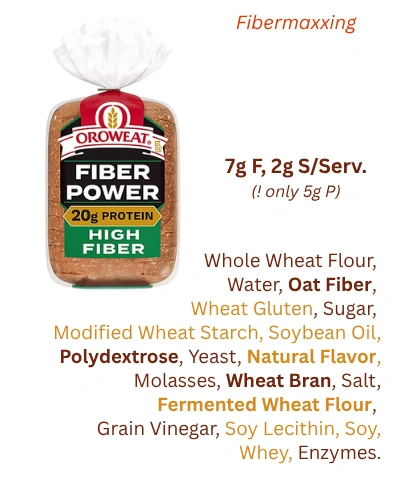
Now look at what’s riding alongside fiber in bread (in color). All carry added sugar – a few grams a slice (here as: S/serv.). Across a two-slice sandwich, that adds up before you’ve spread anything on it. They also list preservatives like calcium propionate and sorbic acid, added specifically to keep a fortified loaf shelf-stable for weeks. Or all the other additives like datem (!), gums and even natural flavors. None of that shows up in the fiber number on the front of the pack – you only see it by turning the loaf around. Here two more examples:
The 10-Second Check for Fiber in Bread
Next time you’re standing in the bread aisle – don’t fall for it! Don’t let shiny names and numbers fool you.
- First ingredient: whole wheat/whole grain flour, or a refined flour like “bleached flour” / “enriched flour”?
- Scan for isolated fiber: oat fiber, wheat bran, sugarcane fiber, polydextrose, inulin, cellulose, chicory root fiber – these are added, not built in.
- Check for added sugar: how many grams, and how far up the ingredient list the sweeteners sit. Look also for honey, molasse, allulose, stevia, syrup or dextrose.
- Preservatives: calcium propionate, sorbic acid, or phrases like “to extend freshness” or “mold prevention” usually mean the loaf is built to last longer than fresh bread naturally does.
- Additives: datem, flavor, gums, lecithin, monoglycerides… are there for production purposes, not for your health.
If high quality flour is doing the work and nothing’s been added to hit the number, that’s how a good bread is doing it the plain way.
One more thing worth knowing: more fiber isn’t automatically better, all at once. Fiber comes in two types (and you need both) – soluble (found in oats, beans, many fruits) and insoluble (found in whole grains, vegetable skins, wheat bran) – and your gut handles them differently. Loading up on either type in one sitting, especially from a concentrated source, is exactly what causes the bloating and discomfort some people report. The better approach isn’t maxing fiber into one loaf or meal – it’s spreading it across a few different sources through the day, in amounts your body’s used to.
Even though there is no official upper limit for fiber intake per day, recommended are 25g for women and 38g for men. Yes, fiber is important for e.g. regular bowl movement, lowering LDL cholesterol and blood sugar levels. But, going way over that does not only give you not more health benefits, on the contrary – it can come with the above metioned discomfort. Too many people misjudge the amount of water they need to drink with an higher fiber intake.
Where Else Fiber Comes From
Which is really where bread comes in – not as the ceiling for a meal, but as one piece of it. A slice or two of good bread, paired with something naturally fibrous, adds up over a day without asking any single food to do all the work.
- Tomato slices on a sandwich – about 1g fiber per medium tomato
- Celery stick alongside – about 1g per stalk
- Carrot sticks or shredded carrot – around 1.5g per medium carrot
- Mashed avocado instead of butter – 3–4g per half avocado
- Pea spread or hummus – 2–3g per 2 tbsp
- Pumpkin or sunflower seeds on top – 1–2g per tablespoon
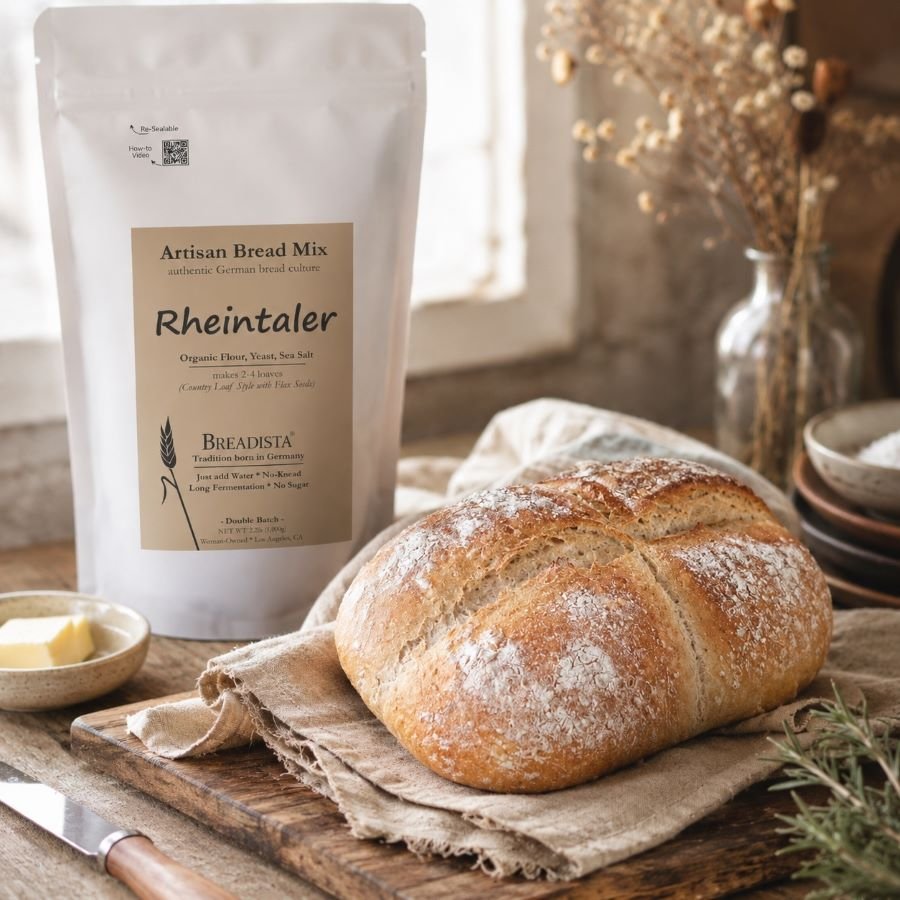
None of it needs a recipe. It’s what’s already sitting in most kitchens, added to a plate that already includes real bread. That said, heading into the kitchen now and making a small lunch tartine: one slice of toasted Rheintaler smeared with avocado, some sprouts, sprinkled with roasted seeds, paired with a tomato and carrot. Voilá, 10-11g of natural fiber from different sources – about a third of the daily intake. The one question that remains – with soft boiled or fried egg?
Final Thought
Fiber doesn’t need to be engineered into a single food to do its job. It works better spread across a plate, from a few different real sources, in amounts your gut can actually handle.
Reading a label this way takes an extra 10 seconds. It’s worth it.
And whenever you’re ready to make your own bread – the kind where the flour does what flour has always done – we’re here for it.
[./. end of post ]
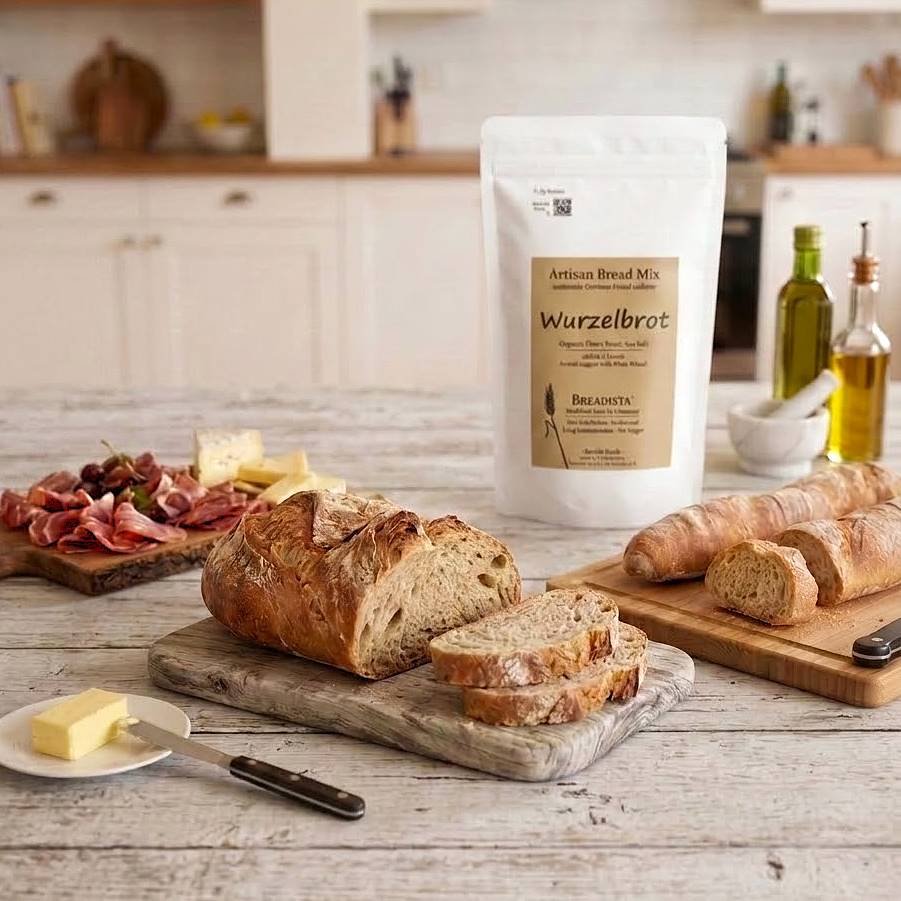
Recommended No-Knead Bread Products:
Worth a read → Bread baking for beginners – Is enriched flour bad for you?
