
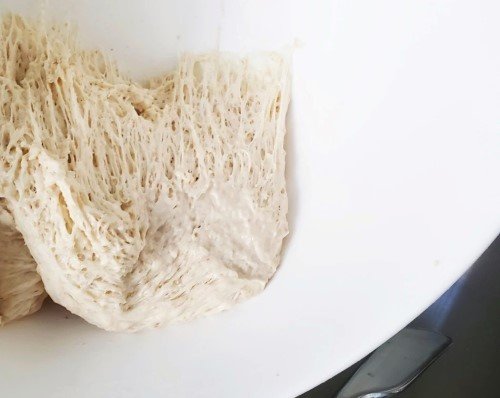
How to rehydrate Sourdough Starter
printable instructions
Simple Feeding & Maintenance
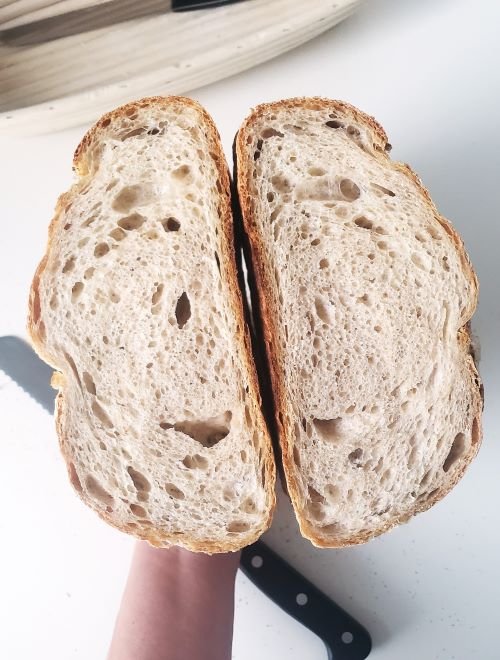
To get to a delicious loaf of sourdough bread the starter needs to be strong and on its peak to deliver.
Following instructions to rehydrate sourdough starter is the way how we activate & maintain our ‘Frieda’ with a robust sourdough culture.
Rehydrate Dried Sourdough Starter In 4-5 days
The whole process starts pretty small and turns into something beautiful bubbly that gives you endless possibilities to bake your favorite loaves.
Good to know: There are many ways to feed and maintain a sourdough starter. Some people follow strict rules and ratios – others not. Over time it gets easier to understand your new little friend and you will find your own way and rules. And, that’s totally fine!
Our instructions to reactivate sourdough starter is the way we handle ‘Frieda’. Our main goal was always to maintain a starter with less discard while keeping it pretty strong.
[To print this page: click all steps open, then scroll to the top and press ‘Strg+P’ or use browser settings]
💡 Notes before you start
- Use a clear 6-8 oz container (drinking glass, glass jar) to see progress more easily until day 3. Move to a pint size jar on day 4.
- Always work with a clean fork, mini spatula and hands to avoid unwanted contamination.
- Flour – At best, stay organic and use the same flour for all feeds. Choose whole wheat or bread flour. (read note)
- Cover your container loosely, but never close it airtight.
- We keep the feeds small and shorten the resting period. Our Frieda likes it that way and we can avoid any starter discard.
- Leave the container on the counter with max temp of 77-80°F. When the temp is <65-70°F it may take a bit longer for each step. But, don’t worry!
- The times below (am/pm) shows our schedule when we did the test runs.
Day 1 – Reyhdrate (11 am)
10 g dried sourdough + 2 TBS filtered/bottled water at room temperature.
- Soak/rehydrate sourdough starter flakes for 2-4 hours until the milky liquid has no hard particles left and is smooth.
- Stir occasionally to help with disolving the starter flakes
Day 1 – Feed Zero (3 pm)
Add 1 TBS organic whole wheat flour + 0.5 TBS filtered water
- Stir everything together until the mass is smooth again.
- Scrape the side walls clean in case you made a mess.
- Rest 12-24 hrs
- (11 pm the starter showed already signs of life with some tiny bubbles.)
Day 2 – Feed #2 (8 am)
Add 1 TBS (10 g) each: organic whole wheat flour + water
- Stir until all is smooth
- Rest 12-24 hrs
- (11 am first new bubbles occured)
Day 2 – Feed #3 (10 pm)
Add 2 TBS (20 g) each: organic whole wheat flour + water
- Stir again until all is smooth
- Rest 20-24 hrs
- In the morning signs will be at the wall of your jar that the starter has risen.
Day 3 – Feed #4 (10 pm)
Add 2 TBS (20 g) each: organic whole wheat flour + water
- Again, stir all together until smooth
- Rest 10-24 hrs
- The jar is now filled with ca. 145 g of starter
Day 4 – Feed #5 (8 am)
Add 50 g each: organic whole wheat flour + water
- In a separate small bowl mix together the starter with the new feed.
- Pour everything into a clean bigger container (1 pint jar)
- The jar is now filled with ca. 245 g of starter
- Rest 2-3 hrs until Frieda rose to 2x/3x her size
- (11 am, first bake can be started – we reccomend a hybrid loaf)
- …or rest for 20-24 hrs since the feed from today.

Day 4 – 1st Bake: Hybrid Loaf (11 am)
Remove 80 g of your acitvated sourdough starter
- In a 4-5 qt bowl mix together 1/2 of your chosen bread mix with the stated amount of water + sourdough starter.
- Mix by hand or with a fork until the dough is equally combined and no dry spot left. Cover with cling foil.
- During next 2 hrs stretch & fold the dough 3x. With wet fingers stretch from the edges to the middle without ripping the dough. Rest in between for 30-40 min.
- After the last stretch & fold, let the dough rest for ca. 6 hrs. (Once your starter gets stronger, you can reduce the amount to 50-60 g for a hybrid loaf and/or put it during this bulk fermentation into the fridge.)
- Shape your loaf on a floured workspace: Degase it lightly, shape your log or boule and place in a well floured banneton. Cover loosely until double in size and a finger imprint springs back slowly. (Ca. 60-90 min depending on kitchen temp)
- Preheat your oven early enough (with baking stone/dutch oven) to have it ready when the dough is.
- Flip your dough gently on parchment paper, score or cut it for a good rise, bake 40-45 min at 450°F. (Remove lid when using dutch oven after 20 min)
Day 5 – Feed #6 (8 am) + 1st Bake: 100 % Sourdough (11 am)
Add 50 g each: organic whole wheat flour + water
- Stir everything together until smooth
- The jar is now filled with ca. 345 g of starter
- Rest 2-3 hrs until Frieda rose to 2x/3x her size
- Now you can start your first loaf (exp: 500 g flour, 10 g salt, 300-320 g water). We recommend 120-150 g of the activated starter as soon as it has doubled.
- Bulk ferment until the dough has at least doubled. (6-10 hrs depending on temperature, flour, total recipe). Bake according to your recipe.
💛 Why Frieda has her name
For us, it stands for robust, strong & resilient – like our Founder’s grandma was. Her middle name was Frieda. She always followed the ‘less is more‘ approach in her life – that was also true with the amount she ate. The human Frieda made it to 97 years on her road of life. That’s why we named our dried sourdough starter after her – in loving memory.
Maintain your fresh Sourdough Starter
After you baked your first loaf with your freshly activated starter, you can go different ways to keep it going. It all depends on how you plan to use it – several days a week or just once? What season of the year and how warm is the kitchen does also play into your maintance schedule.
Keeping a sourdough starter on the counter
As long as the temperature does not stay at 77°F or higher for most of the time, you can keep your starter jar out of the fridge. To keep it just ‘alive’ without baking, feed it once every 1-2 days with just a small amount of equally flour + water; ca. 10-15% each should be enough.
For example: 160 g starter = 16-24 g each of flour + water (ca. 1.5-2 TBS ea.) per feed every other day. You can (no must) stir the non-feed day without a feed.
Keeping a sourdough starter in the fridge
When the bakes are only planned for once a week or even less, keep your jar in the fridge while leaving the lid a bit loose. Take it out once a week to get it acclimated for some hours before you feed it.
Again, there are different ways for a feeding schedule, here are ours:
- When you have a big amount in the fridge take away the portion you need for the recipe you want to bake and feed that part separately. Or use it direct, whatever your recipe calls for.
The rest of the starter gets only a small feed like the same 10-15% of the base amount as described above. That way you do not produce too much and the need of discarding starter is usually not given.
Leave it out for ca. 1.5 hours to get it started before you’re putting it back into the fridge for another week. - When you have a small amount in the fridge feed that amount with the grams you need for the recipe (ratio 1:1 – water:flour). Let it rise to its peak, take out the amount you need for the recipe and let the rest sit for some more hours. Then put it back aside or into the fridge til you need it again.
It may sound controversial for some people because many are tought differently. This is our humble and easy way to maintain Frieda without putting stress on ourselves. She is a very robust sourdough culture to give you the leavening power you need for your loaves. Treat her with organic high quality flour (whole wheat at best) and she will be your next best friend.
Last Remarks
A sourdough culture is a 100% natural product and so it has sometimes its own rules. It can have picture perfect, good or less good days – like humans do. That does not mean your starter is dead or bad. It may need just a bit longer to get going.
When you feed any starter with a flour it was not used to, it can also take some extra couple of hours to get as strong as it was before. That’s normal. New flour brings new bacteria which needs to adjust to the old enviroment. The goal is to get it 2-3x the size within 2-3 hours to be considered strong before you should at it to your recipe.
👉 Looking to buy Frieda starter? Or do you have any questions to your Frieda schedule? Let us know and we’ll help you out.